See History Timeline
Local government in Sierra Leone prior to the civil war had changed remarkably since the days of colonial “indirect rule”. During the colonial period, it comprised a system of field administration coordinated by District Officers, and chieftaincy structures at local level.
District councils were established in 1946 and took on responsibility for primary education - all native administrative schools came under the direct administration and supervision of the District Councils, and Supervisors appointed by district councils were in charge of primary school supervision. Education campaigns were carried out to encourage people to send their children to schools, and scholarships were awarded by district councils to enable students to pursue both secondary and tertiary education outside their indigenous communities.
As a result, educational and political commentators argued that district councils positively contributed to educational development in the provinces.
The primary objective of creating district councils was to involve local people in the governance of their districts and the country as a whole. According to the District Councils Act, Cap 79 of the Laws of Sierra Leone, District Councils had the following responsibilities:
a) To promote the development of the district and the welfare of its people;
b) To advise on any matter brought before it by government;
c) To make recommendations to government on issues affecting the welfare of districts;
d) To act as commissions of enquiry into local matters such as boundary disputes and complaints against chiefs.
The establishment of District Councils in the provinces laid the foundation for social, cultural, economic, educational and political development in the provinces. The councils formed training grounds for young ambitious talented rural people who were interested in governance to actively participate in the local politics of their communities, and the education gained during their apprenticeship in councils paved ways for their absorption into national politics:
National political leaders such as Sir Milton Margai, Sir Albert Margai and Siaka .P. Stevens, who became heads of state, went through the District Councils to gain political prominence. As a result of the training and knowledge gained during their participation at district level, they became the leading advocates of independence of Sierra Leone in 1961. Against this backdrop, it can be asserted that District Councils played a vital role in the political development of Sierra Leone before and after independence onto 1972.
In spite of the fact that the new republic was deeply in need of local government reforms after independence in 1961, the Government of Sir Milton Margai suspended District Councils in 1962 on the charges of maladministration and corruption. Immediately after the death of Sir Milton Margai in 1964, the new Prime Minister Sir Albert Margai decided to revive district councils in 1965, only for them to be suspended again by the National Reformation Council (N.R.C.) military regime in 1967, led by Brigadier Lansana.
Due to corruption and maladministration in the early 1970s, the APC-led government of Siaka Stevens abolished district councils in 1972 and replaced them with non-elective committee members.
In 2004, the Government of Sierra Leone opted for a rethink of its National Governance arrangement by embarking on the resuscitation of democratically elected Local Government after 32 years experimenting with central Government appointed District and Municipal Governments. The decision by the Government and the People of Sierra Leone was driven by a primary consideration to address the country’s seeming non-performance in the areas of citizens’ participation in governance and responding to the needs of citizens as it relates to attainment of the Millennium Development Goals (MDGs) as well as ensuring poverty reduction in the country.
A new Local Government Act (LGA) was ratified in February 2004, Inaugural Local Council elections were held in May 2004.
By 2007, Sierra Leone had a fully functional tier of town and District Councils, a new and well-regulated system of fiscal transfers from Central to Local Government, increased investment in local services and regular production of participatory development plans.
In 2008 a second round of local council elections was successfully completed.
Makeni until 2006 had only one Council “Makeni Town Council”; but by the President’s proclamation as stated in Part II section 2 and 3 subsections (1) and (2) of the Local Government Act of 2004, late Former President Dr. Alhaji Ahmed Tejan Kabba declared Bombali District a new locality; and later in 2008 Former President Dr. Ernest Bai Koroma declared Makeni a City. Using the same prerogative, former President Koroma declared three (3) new localities- Portloko City, Falaba District and Karene District in 2017 making it 22 Local Councils across the country.
Bombali District Council headed by a Chairman and the Makeni City Council by a Mayor are co-located councils overseeing their different jurisdiction with the same mandate to bring development to the doors of their citizenry.
The Decentralization Process which ushered in Local Councils has acquired a dual rationale: a) improving development planning and service delivery (poverty reduction and good governance); b) reincorporating alienated populations into national and local development processes.
Several studies identify the over-concentration of political, administrative and economic power in the capital Freetown as a root cause of rural poverty and the chaotic civil war of the 1990s. An additional reason to decentralization was to reform/replace the archaic and conflicted system of governance in the provinces, inherited from colonial “indirect rule”.
Chieftaincy, the backbone of this governance system, appeared to be undergoing a terminal crisis of popular legitimacy at the end of the war.
Decentralization had been national policy in Sierra Leone for many years and the Political will for decentralization after the civil war seemed strong.
The Decentralization Process ushered in Local Councils in the 1960s on the grounds that Central government is unlikely to have the capacity to assess the diversity of local conditions or local requirements and capabilities. Their staff is more trained and experimented, but their services are also more remote and costly.
Conclusively, Local Government is better informed than the central government about local needs, more familiar with and more sensitive to them. They are also better placed to identify the poor, to respect local social identities, to value forms of collective action and self-help preferences. To support social inclusion, and to respond more efficiently to local variations in conditions, tastes, standards, affordability, location requirements and so on for services and infrastructure; these I believe formed the basis of their establishment.
Brief Characteristics of Makeni City and the Makeni City Council:
Makeni City is located in the Northern District of Bombali and it is the north-east regional headquarter City. Due to rapid growth over the years the City has expanded and the land occupied by the City is made up of sections of the Bombali Sebora Chiefdom. The city is relatively flat and it is bounded on the north by Mena Hills and on the west by the Wusum Hills.
The population of the city has grown to about 126,000 inhabitants based on the 2015 national census. 51.8% of the total population is female and 48.2% is male. 34.6% of the female population is between the age group 15-39, while that of male for the same age group is 35.6%. People with disability both female and male form a tiny portion of the population, less than 0.005%.
Socio-Economic Situation
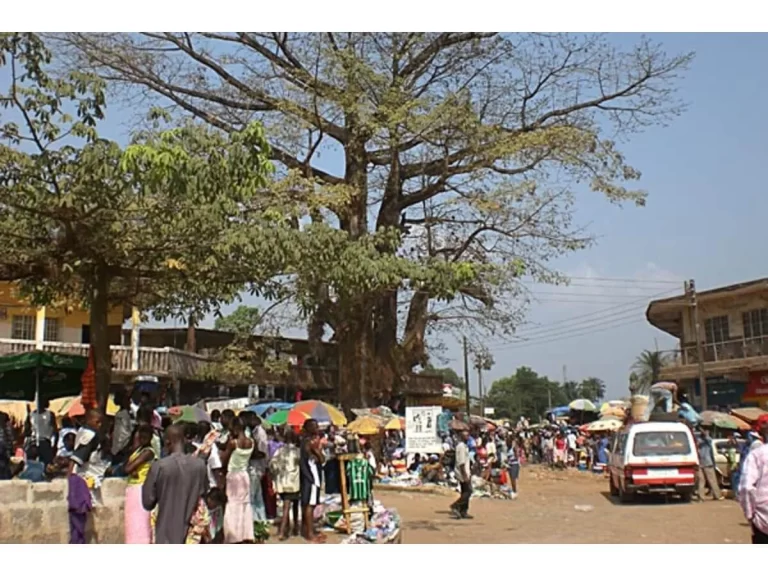
The economy of Makeni City is dominated mainly by small scale agricultural activities and micro businesses, both sectors account for about 45% and 35% of the labour force respectively and they therefore represent the main source of income and livelihood for most of the inhabitants of the City. The main cash crops produced by small scale farmers within the City are rice and oil palm. Other crops that are produced on a significant scale include cassava, vegetables, plantain, banana, yam, tomato and pepper. These farmers are also rearing livestock though on a small scale. Most of the products are being sold raw because of the lack of industries and post-harvest processing facilities (Value addition Opportunities). About 50% of the population of the city is considered poor by the 2015 census. This is not surprising because of the low income generation capacity of the population and the high level of unemployment among citizens. The housing situation is on average. The fast growing population and the high migration into the city from surrounding towns have created a refuse management challenge with huge investment needs especially for the establishment of landfill sites, the transportation of waste to landfill sites and the provision of waste collection bins in and around the city.
Political and Administrative Arrangement of Makeni City Council
Makeni City Council comprises of Sixteen (16) elected councillors from the 3 wards (121, 122 and 123) from Bombali Sebora Chiefdom in the Bombali district. These Councillors together with the Mayor are tasked with the responsibility for policy making. The Council has a paramount chief who acts as ex – officio member.
The Administrative wing of the Council is headed by a Chief Administrator under the direct supervision of the Mayor who heads the Political Wing. The Deputy- Chief Administrator is an important officer who supports the Chief Administrator in the day-to-day operations of the council and the supervision of the technical core staff (14) and auxiliary staff.
Legal Mandate and Functions
Makeni City Council (MCC) is one of the Twenty Two Local Councils created by an Act of Parliament in 2004. By statutory provision of the Local Government Act 2004 (LGA 2004), the Council is the highest political authority in the municipality with legislative and executive powers to be exercised in accordance with the Local Government Act of 2004.The Council is responsible for promoting development and the welfare of the people within the Municipality with the limited resources at their disposal and with such resources and capacity they can mobilize from central government and its agencies, national and international organizations, and the private sector.
There are Six (6) City Councils and Sixteen (16) District Councils across the Country